
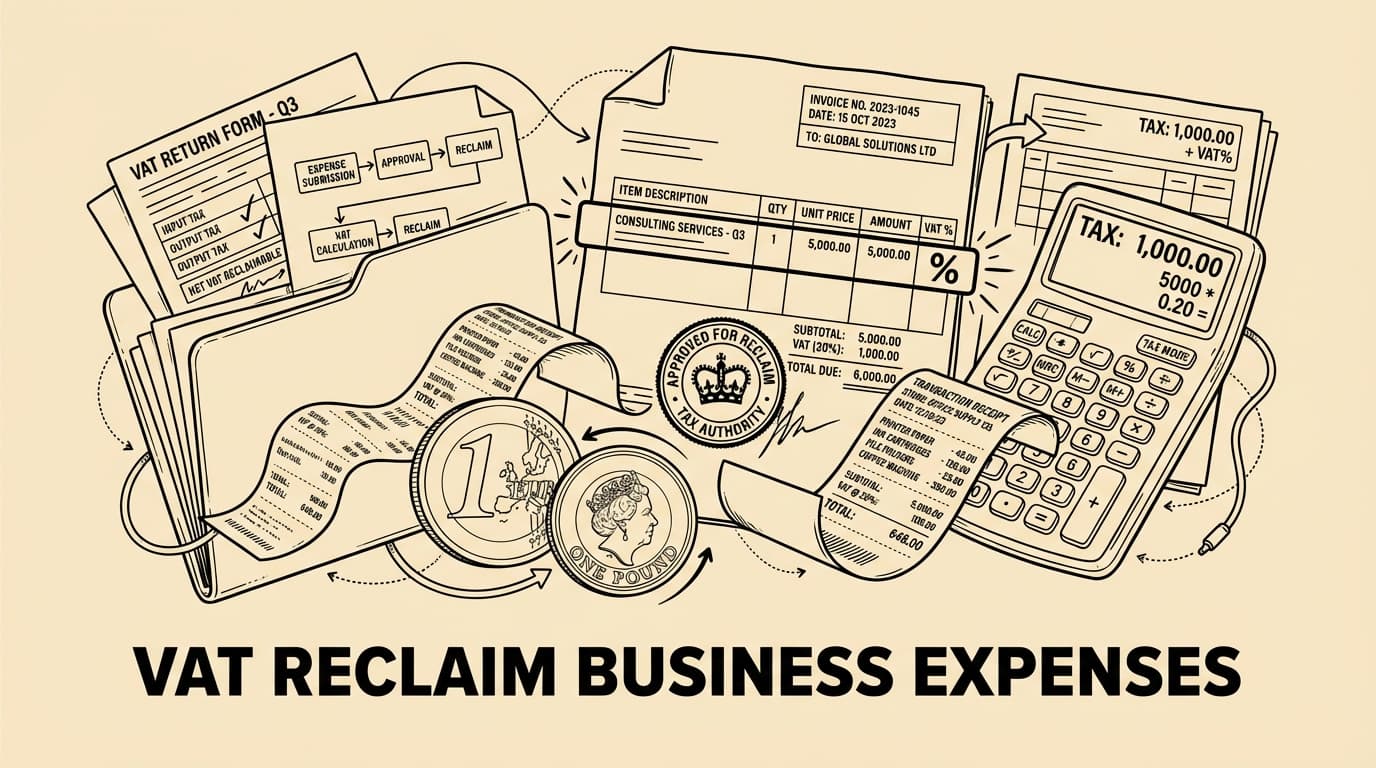
Value Added Tax (VAT) is an unavoidable part of business spending across Europe and beyond. But here's the opportunity most businesses overlook: a significant portion of that VAT is legally reclaimable. Whether you're paying 20% VAT in the UK, 19% in Germany, or 25% in Scandinavia, properly reclaiming input tax can save your business thousands annually. This guide walks you through every aspect of VAT reclaim on business expenses—from eligibility rules and common pitfalls to digital tools that automate the process.
What Is Input VAT and Why Does It Matter?
When your business buys goods or services for business purposes, you pay VAT as part of the price. This is called input VAT. If your business is VAT-registered, you can offset this input VAT against the VAT you collect from customers (output VAT), effectively recovering the cost.
The mechanics work like this: if your output VAT for a quarter is €10,000 and your reclaimable input VAT is €3,000, you only remit €7,000 to the tax authority. If input VAT exceeds output VAT, you receive a refund. For businesses with high operating expenses, this can represent a substantial cash flow benefit.
Which Business Expenses Are VAT-Reclaimable?
The general rule is that input VAT is reclaimable when expenses are wholly and exclusively for business purposes. Qualifying categories typically include:
- Office supplies and equipment — computers, printers, furniture, stationery
- Professional services — accountancy, legal advice, consultancy fees
- Business travel — train tickets, flights, car hire (conditions apply)
- Accommodation — hotel costs for overnight business travel
- Marketing and advertising — print, digital, events, trade shows
- Utilities and premises — business premises only, proportionate use
- Software subscriptions — SaaS tools, licenses used for business
- Catering for employees — in certain circumstances, staff entertainment
Common Expenses Where VAT Cannot Be Reclaimed
Knowing what you cannot claim is equally important to avoid errors that trigger audits:
- Business entertainment — taking clients to dinner is generally blocked (HMRC explicitly excludes client entertainment in the UK)
- Personal vehicle fuel — unless you have a fuel scale charge agreement or the vehicle is used exclusively for business
- Private use portion — if an asset has mixed personal and business use, only the business proportion qualifies
- Exempt supplies — businesses making exempt supplies (insurance, financial services, medical) may only partially recover VAT
Documentation Requirements: What You Must Keep
A valid VAT invoice is your primary evidence for reclaiming input tax. Under UK HMRC rules and EU VAT Directive requirements, a proper VAT invoice must show:
- Supplier's name, address, and VAT registration number
- A unique invoice number
- Date of supply (tax point)
- Description of goods or services supplied
- Net amount excluding VAT
- VAT rate applied
- Total VAT charged
- Gross total including VAT
For purchases under £250 (UK) or equivalent thresholds in other jurisdictions, simplified invoices (such as till receipts) may suffice, provided they show the supplier's VAT number and the VAT amount.
Under Making Tax Digital (MTD) rules in the UK, digital records must be kept in a functional compatible software system. EU countries have their own digital requirements, with Germany's GoBD specifying machine-readable, tamper-proof storage for all tax-relevant documents.
The Partial Exemption Problem
If your business makes both taxable and exempt supplies, you face the partial exemption challenge. You can only reclaim input VAT that relates to taxable business activities. The calculation involves an apportionment method agreed with your tax authority.
Common apportionment methods include:
- Standard method — based on the ratio of taxable to total turnover
- Special methods — agreed with the tax authority for businesses where the standard method doesn't give a fair and reasonable result
Partial exemption calculations are typically done annually, with provisional reclaims made during the year and adjusted at the annual capital goods scheme review.
Cross-Border VAT Reclaim
If your business incurs VAT in another EU member state or the UK post-Brexit, you can still reclaim it—but the process differs significantly from domestic claims.
Within the EU: The EU VAT Refund Directive (Directive 2008/9/EC) allows businesses to reclaim foreign VAT electronically through their domestic tax portal. UK businesses must now file separately with each EU country's tax authority via their own national portals since Brexit.
Outside the EU: Many countries have bilateral refund arrangements. Always check whether the foreign jurisdiction permits VAT reclaims from your country of registration.
Claims must typically be filed within specific deadlines — usually by September 30 of the year following the incurred expenses. Missing these deadlines forfeits your right to reclaim.
Motor Vehicles: A Special Case
Vehicle-related VAT reclaims are among the most complex and most frequently audited areas:
- Commercial vehicles (vans, trucks) used exclusively for business — full VAT reclaim generally permitted
- Cars — in the UK, VAT on car purchases is blocked except for taxis, driving schools, and cars demonstrably available exclusively for business use. Many EU countries have similar restrictions.
- Fuel — if a car has any private use, you must either restrict your fuel reclaim to the business proportion or pay a fuel scale charge based on CO2 emissions
- Leased vehicles — typically 50% input VAT recovery on lease payments for cars with any private use
Practical Tips for Maximising Your VAT Reclaim
1. Capture Receipts in Real Time
The most common reason for missed VAT reclaims is lost or incomplete receipts. Using expense management software that captures receipts via mobile camera immediately ensures nothing falls through the cracks. Tools like Bill.Dock automatically extract VAT amounts from receipt images, categorise expenses, and flag any that don't meet VAT invoice requirements before submission.
2. Reconcile Monthly, Not Quarterly
Even if you file quarterly VAT returns, reconcile your expense records monthly. This catches errors, missing invoices, and duplicates while records are fresh and correctable. A quarterly review of a quarter's worth of expenses is far more error-prone than monthly spot-checks.
3. Maintain a VAT-Only Receipt Folder
Separate your VAT-reclaimable invoices from non-reclaimable ones. This simplifies your quarterly return preparation and makes audits significantly less stressful.
4. Review the Supplier's VAT Number
Always verify that a supplier's VAT number is valid before processing a large invoice. In the UK, HMRC provides an online VAT number checker. Reclaiming VAT on an invoice with an invalid or fraudulent VAT number can result in the reclaim being disallowed and penalties applied.
5. Understand Your Partial Exemption Position
If you're in a mixed-activity business, invest time in agreeing a fair apportionment method with your tax authority upfront. A poorly structured method can cost more in under-claimed input VAT than it saves in compliance effort.
Frequently Asked Questions
Can I reclaim VAT on expenses paid personally by employees?
Yes, if the expenses are for genuine business purposes and the employee provides a valid VAT receipt. The reclaim is made by the business (not the employee) on the VAT return. Reimburse the net amount plus VAT to the employee.
What happens if I reclaim VAT I wasn't entitled to?
HMRC and EU tax authorities take incorrect input tax reclaims seriously. Penalties range from interest on the over-reclaimed amount to significant financial penalties for deliberate errors. In cases of suspected fraud, criminal prosecution is possible. Honest mistakes discovered and corrected promptly typically attract only interest.
How far back can I reclaim VAT I missed?
In the UK, you have four years to reclaim input VAT you were entitled to but missed. Many EU countries have a three-year window. Claims are made by adjusting a subsequent VAT return, though very large retrospective claims may require a separate error correction form.
Do I need to keep original paper receipts or are digital copies sufficient?
Under MTD in the UK and equivalent digital bookkeeping rules across the EU (e.g., GoBD in Germany), digital records are accepted—and increasingly required. Your digital records must be stored in a format that cannot be altered after entry, and must remain accessible for the full retention period (typically six to ten years depending on jurisdiction).
Can a non-EU business reclaim VAT charged on EU expenses?
Many EU countries do allow VAT reclaims by non-EU businesses under the 13th Directive, but conditions vary by country and reciprocal agreements. This typically requires an appointed fiscal representative and a specific annual claim process. Consult a tax advisor familiar with the specific country's rules.
Streamlining VAT Reclaim with Expense Management Software
Manual VAT reclaim processes are time-consuming and error-prone. Each receipt must be checked for validity, categorised, matched to the correct VAT rate, and recorded against the correct accounting period. For businesses with high transaction volumes, this creates significant administrative burden.
Modern expense management tools like Bill.Dock automate the heaviest lifting: OCR technology reads VAT invoices, extracts the relevant fields, validates VAT numbers, and flags receipts that don't meet the requirements for input tax reclaim. When integrated with your accounting system, this data feeds directly into your VAT return preparation, reducing both effort and error risk.
The result is not just time savings—businesses using automated expense capture typically identify 15–25% more reclaimable VAT than those relying on manual processes, simply because fewer receipts are lost or overlooked.
Conclusion: VAT Reclaim as a Cash Flow Strategy
VAT reclaim isn't just a compliance obligation—it's a genuine cash flow management tool. With proper systems in place, the VAT you pay on business expenses flows back to your business quarterly, reducing your effective cost base and improving working capital. The investment in proper expense documentation and automated capture tools pays back many times over in recovered VAT and reduced compliance risk.
Start with a clear policy on what expenses qualify, ensure your team captures receipts in real time, and consider tools like Bill.Dock to automate the process from receipt to VAT return. Your finance team will thank you, and so will your cash flow.