
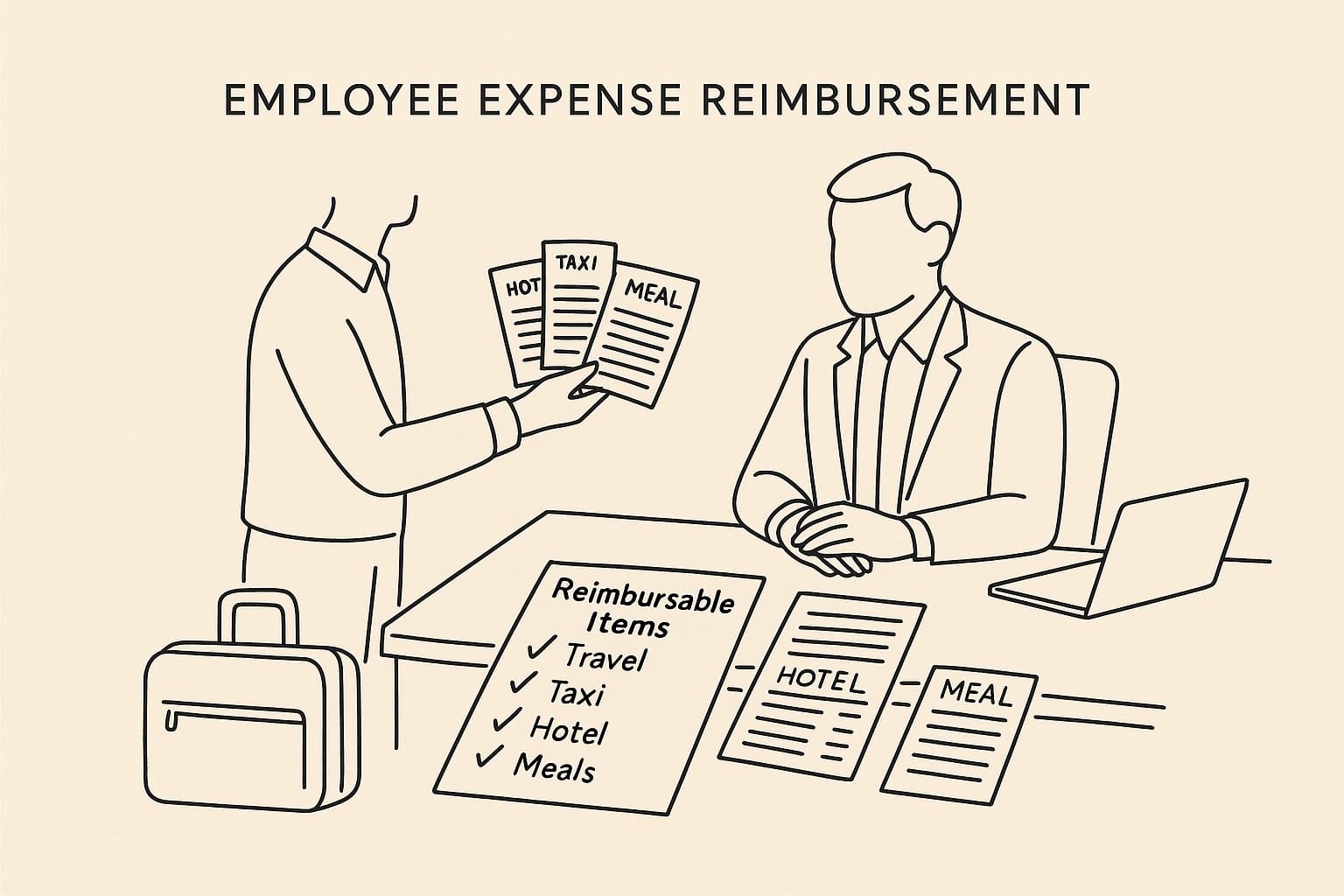
What Are Reimbursable Employee Expenses? A Complete Guide
When employees spend their own money on legitimate business activities, companies are expected to pay them back. These are reimbursable employee expenses — one of the most common, and most mismanaged, areas of corporate finance. This guide explains exactly what qualifies, what the rules are across Europe, how to build a solid reimbursement policy, and how modern tools like Bill.Dock make the whole process frictionless.
What Does "Reimbursable Employee Expense" Mean?
A reimbursable employee expense is any out-of-pocket cost an employee incurs while performing work duties, which the employer is required or has agreed to pay back. The expense must:
- Be work-related and serve a legitimate business purpose
- Be supported by documentation (receipt, invoice, ticket)
- Be submitted within the company's defined timeframe
- Be approved by an authorized manager or finance function
The Most Common Categories of Reimbursable Expenses
1. Business Travel
Travel is the single largest category. Reimbursable travel costs typically include:
| Expense Type | Typically Reimbursable | Notes |
|---|---|---|
| Flights (economy) | ✅ Yes | Business class needs pre-approval |
| Train tickets | ✅ Yes | Choose most economical option |
| Hotel stays | ✅ Yes | Per policy cap (e.g. €150/night) |
| Taxi / Uber | ✅ Yes | When public transport impractical |
| Car rental | ✅ Yes | Requires business justification |
| Personal vehicle (mileage) | ✅ Yes | At statutory rate (see below) |
| Airport parking | ✅ Yes | With receipt |
| Personal side trips | ❌ No | Strictly private |
| Flight upgrades (personal) | ❌ No | Unless company policy allows |
2. Meals and Per Diem
Per diem rates vary significantly by country. In most European jurisdictions, the tax-free per diem rates for 2026 are:
| Country | Full Day (Domestic) | Overnight Absence | Partial Day |
|---|---|---|---|
| Germany (DE) | €28 | €28 | €14 (>8h) |
| Austria (AT) | €26.40 | €26.40 | €13.20 (>3h) |
| Switzerland (CH) | CHF 70 | CHF 100 | CHF 35 |
| Denmark (DK) | DKK 584 | DKK 584 | DKK 292 |
| Netherlands (NL) | €33.70 | €33.70 | €16.85 |
| Norway (NO) | NOK 695 | NOK 695 | NOK 347 |
| Sweden (SE) | SEK 520 | SEK 520 | SEK 260 |
| Spain (ES) | €53.34 (abroad) | — | €26.67 |
| Italy (IT) | €46.48 | €46.48 | €23.24 |
⚠️ Important: Amounts above the statutory threshold are subject to income tax and social security contributions. Always confirm current rates with your tax advisor.
3. Mileage and Vehicle Costs
When employees use their personal vehicles for business, they receive a mileage reimbursement at the statutory rate:
| Country | Rate per km (2026) | Notes |
|---|---|---|
| Germany | €0.30/km | Up to €0.38 for EVs |
| Austria | €0.42/km | Car; €0.24 motorcycles |
| UK | £0.45/mile (first 10k mi) | HMRC approved |
| Netherlands | €0.23/km | WKR standard |
| Norway | NOK 3.50/km | Statens satser |
| Sweden | SEK 25/mil (10km) | Skatteverket |
| Denmark | DKK 2.23/km | Skattestyrelsen |
4. Client Entertainment
Meals and events with clients are reimbursable — up to a point. German tax law (§4 Abs. 5 EStG), for example, limits the deductible portion of client meals to 70% of the invoice amount. In Austria, similar restrictions apply.
What must be documented:
- Names and companies of all attendees
- Business purpose of the meeting
- Original receipt (VAT-compliant invoice)
5. Office Supplies and Software
Remote workers and consultants often buy supplies that are clearly work-related:
- Stationery, printer paper, ink cartridges
- Software subscriptions (productivity tools, professional licenses)
- Books and professional publications
6. Training and Professional Development
Course fees, certification exams, and professional memberships are reimbursable when directly relevant to the employee's role.
7. Home Office Costs (Post-COVID)
With hybrid work now standard, many companies reimburse a portion of:
- Home internet costs
- Ergonomic office furniture (chair, monitor stand)
- Electricity surcharges (a monthly flat rate is common)
What Is NOT Reimbursable?
Companies should be crystal clear about non-reimbursable expenses. Common exclusions:
- Commuting costs (from home to regular workplace) — these are generally the employee's personal expense
- Fines and parking tickets
- Personal clothing (unless it's a uniform or safety gear required by law)
- Spouse or family travel (unless pre-approved for a specific business purpose)
- Alcohol above the per diem or in contexts not related to business
- Personal entertainment (streaming subscriptions, leisure activities)
- Cash withdrawals without receipts
- Expenses outside the submission deadline
Building a Solid Expense Reimbursement Policy
A clear policy protects both the company and the employee. Here's what every expense policy should include:
1. Scope and Eligibility
Define which employees and expense types are covered. Contract workers, freelancers, and board members often have separate rules.2. Spending Limits
| Category | Typical Cap |
|---|---|
| Hotels (per night) | €100–€180 depending on city |
| Flights (domestic) | Economy only |
| Meals with clients | €75–€120 per person |
| Team lunches | €25–€40 per person |
| Taxis / rideshare | Require justification over €50 |
| Individual purchases | Require pre-approval over €250 |
3. Submission Deadline
Most companies require submission within 30–60 days of the expense. Beyond this, the expense may be denied or — in Germany — treated as taxable income if reimbursed late without written exception.4. Required Documentation
- Original receipt or VAT-compliant invoice
- For client meals: attendee list and business purpose
- For mileage: route, purpose, km driven
5. Approval Workflow
- Manager approves expenses up to €500
- Finance or CFO approves above €500
- Recurring travel budgets for road warriors: pre-approved monthly allowance
6. Payment Timeline
Employees should receive reimbursement within 7–14 working days of submission approval. Delayed payments damage morale and trust.Tax Implications: What Employers and Employees Need to Know
For Employers (Germany example)
- Reimbursements at or below statutory rates are tax-free for both employer and employee
- Excess reimbursements are treated as wages and are subject to wage tax (Lohnsteuer) and social insurance
- The employer can elect to tax excess amounts at a flat 25% (§40 EStG pauschaliert) rather than adding to individual wage tax
For Employees
- Legitimate business expense reimbursements are not taxable income
- If you pay out-of-pocket and are not reimbursed by your employer, you may claim as Werbungskosten (business expenses) on your annual tax return — subject to the flat-rate deduction (€1,230 in Germany)
- Keep all original receipts for at least 10 years (EU standard; GoBD in Germany, AFIP in Spain, etc.)
VAT Recovery
For companies registered for VAT, reimbursed expenses often carry VAT that can be reclaimed. This requires an invoice made out to the company (not the employee personally). A receipt from a hotel or restaurant made out to the employee personally may not qualify for input tax recovery.The Manual Expense Process: Why It Breaks Down
The traditional expense reimbursement process looks like this:
1. Employee collects paper receipts during a business trip 2. At month-end, manually enters data into an Excel template 3. Scans or photographs receipts (variable quality) 4. Emails spreadsheet + attachments to manager 5. Manager reviews, approves, forwards to finance 6. Finance manually re-enters data into accounting system 7. Accountant reconciles for VAT, categories, cost centres 8. Employee gets paid — 3–6 weeks after the expense
The pain points:- Lost receipts → denied reimbursements → frustrated employees
- Data entry errors in amounts, dates, VAT codes
- Receipts fade, rendering them audit-invalid
- Finance spends hours on manual reconciliation
- Expense fraud is harder to detect without automated controls
- Late submission = payroll complications
How Automated Expense Management Works
Modern expense management tools like Bill.Dock replace the paper-and-spreadsheet workflow with:
Step 1: Capture Receipts Instantly
Snap a photo of a receipt on your phone. AI reads the merchant name, date, amount, currency, and VAT automatically. No manual data entry.Step 2: Auto-Categorization
Machine learning assigns expense categories based on merchant type. Correctable with a tap.Step 3: Policy Enforcement
The system flags policy violations in real time — over-limit meals, missing client names, late submissions — before the claim even reaches a manager.Step 4: Approval Workflows
Configurable multi-level approval. Managers review and approve on mobile. Finance gets a clean, structured export.Step 5: Accounting Integration
Direct export to DATEV, lexoffice, sevDesk, Exact Online, Fortnox, and other regional accounting platforms. Journal entries are generated automatically with correct cost centre codes.Step 6: Reimbursement
Integration with payroll or direct bank transfer via SEPA batch payment. The result: What took 3–6 weeks takes 2–3 days. Process cost drops by 60–80%.Choosing the Right Tool for Your Team
| Feature | Spreadsheet | Bill.Dock | Legacy ERP |
|---|---|---|---|
| Mobile receipt capture | ❌ | ✅ | ⚠️ (limited) |
| AI data extraction | ❌ | ✅ | ❌ |
| Policy enforcement | ❌ | ✅ | ⚠️ |
| DATEV/lexoffice export | ❌ | ✅ | ✅ |
| Per diem automation | ❌ | ✅ | ⚠️ |
| Multi-currency | ❌ | ✅ | ✅ |
| Setup time | Hours | Minutes | Weeks |
| Cost (50 users) | €0 | ~€99/month | €500+/month |
Practical Checklist: Expense Reimbursement Best Practices
For Employees:- [ ] Capture every receipt at the point of purchase (don't wait)
- [ ] Note business purpose immediately (memory fades)
- [ ] Submit within your company's deadline — usually 30 days
- [ ] Check that VAT invoices are made out to your company
- [ ] Keep digital copies; originals may be required for audit
- [ ] Publish a clear, concise expense policy (max 2 pages)
- [ ] Train employees on what's reimbursable and what isn't
- [ ] Set up automatic policy alerts before claims reach approval
- [ ] Reconcile expense data with bank statements monthly
- [ ] Archive all documentation for the statutory retention period (7–10 years)
- [ ] Review expense claims promptly — don't let the queue build
- [ ] Escalate unusual patterns (same merchant every week, round-sum cash claims)
- [ ] Update policy annually for new statutory rates (per diem, mileage)
- [ ] Onboard new hires on the expense process on day one
Expense Reimbursement and Expense Fraud
Expense fraud is more common than most companies acknowledge. Studies suggest 5–15% of business expenses contain some element of misrepresentation — from inflated amounts to personal items slipped into business claims.
Common patterns:
- Duplicate receipt submissions
- Personal meals claimed as client entertainment (without attendee names)
- Inflated mileage logs
- Fictitious vendors (less common, but high-value when it occurs)
- Flagging duplicate receipts by merchant + date + amount
- Cross-referencing claimed mileage against calendar/travel records
- Requiring attendee documentation for client meals above a threshold
- Generating anomaly reports for finance and audit review
Tools and Resources
- Bill.Dock Expense Tools — Receipt scanner, mileage tracker, per diem calculator
- Germany: BMF Schreiben zu Reisekosten (latest version), DATEV Reisekostenabrechnung guide
- Austria: WKO Reisegebühren Übersicht, BMF Pendlerpauschale
- Netherlands: Belastingdienst onkostenvergoeding
- Denmark: Skattestyrelsen rejsegodtgørelse
- Sweden: Skatteverket traktamente och milersättning