
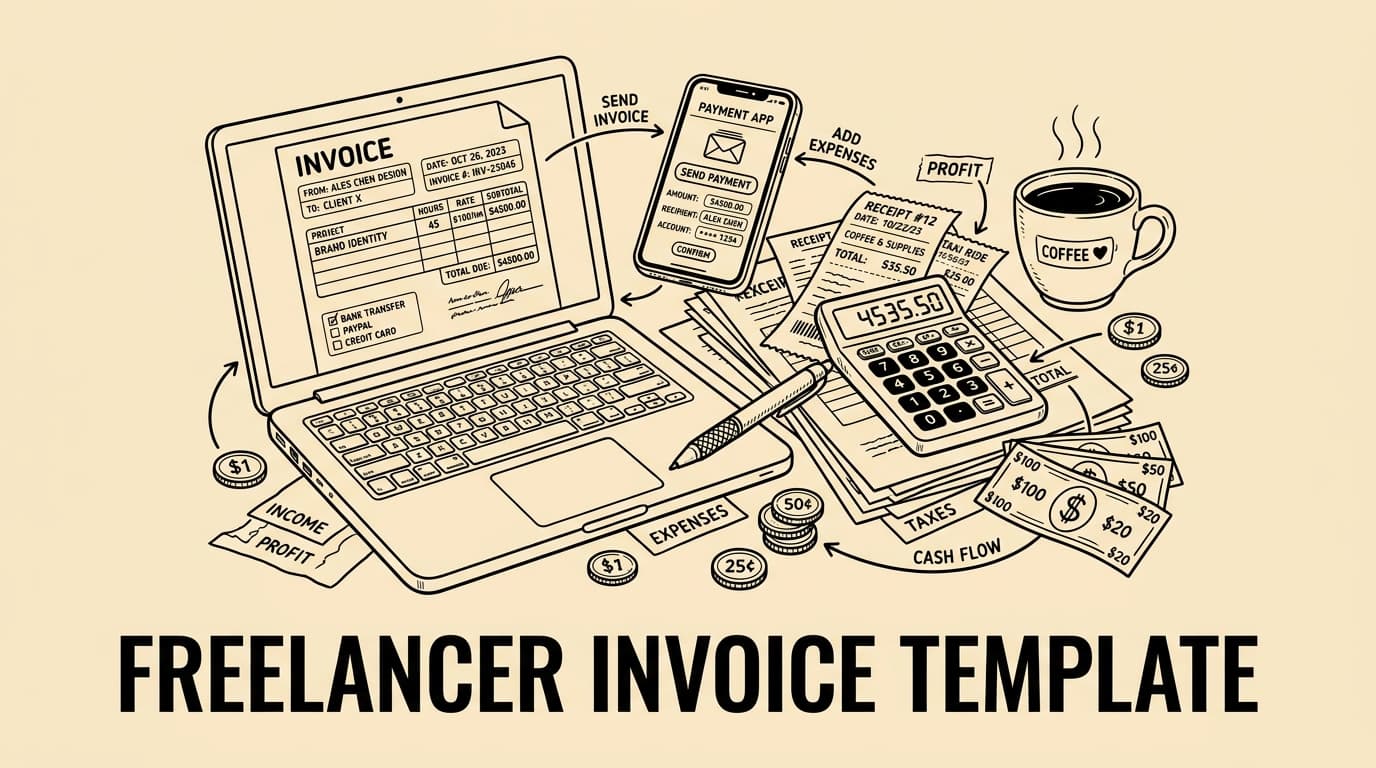
As a freelancer, getting paid on time is just as important as delivering quality work. Yet many independent professionals struggle with one critical aspect of their business: creating professional, legally compliant invoices that clients actually pay promptly. Whether you are a graphic designer in London, a software developer in Berlin, or a marketing consultant in Madrid, a well-structured invoice is your most important financial document. It is not merely a request for payment; it is a legal record, a tax document, and a reflection of your professionalism all rolled into one.
In this comprehensive guide, we will walk you through everything you need to know about freelancer invoicing. You will learn what makes an invoice legally valid, which elements no invoice should miss, how to structure your payment terms, and how to handle late payments without damaging client relationships. We will also provide practical tips for different jurisdictions and show you how modern tools like Bill.Dock can automate much of this process, saving you hours every month.
Why Every Freelancer Needs a Professional Invoice Template
When you are just starting out as a freelancer, it is tempting to send informal payment requests via email or even messaging apps. Some beginners simply write a few lines describing the work and asking for money. While this might work occasionally with friends or very small clients, it creates serious problems as your business grows.
First, informal payment requests lack legal standing. If a client disputes your charge or refuses to pay, you have no formal document to present to a court, mediator, or tax authority. A proper invoice, by contrast, is a legally recognized document that establishes a debt. Second, unprofessional invoicing damages your brand image. Clients judge your reliability partly by how professionally you handle administrative tasks. A sloppy invoice suggests sloppy work. Third, tax authorities in most countries require freelancers to issue formal invoices for all business income. Failing to do so can result in fines, denied tax deductions, or even accusations of tax evasion.
A professional invoice template solves all these problems at once. It ensures every invoice you send contains all legally required elements. It presents your business consistently and professionally. And it creates a paper trail that makes tax reporting and financial tracking much easier. Best of all, once you have a good template, creating each new invoice takes just a few minutes.
The Essential Elements of a Freelancer Invoice
Every valid invoice, regardless of country or industry, must contain certain core elements. Missing any of these can delay payment, create legal vulnerabilities, or cause problems with your tax filing. Here is what every freelancer invoice should include:
1. Your Business Information
Your invoice must clearly identify who is sending it. Include your full name or business name, your registered business address, and your contact details (email and phone). If you operate through a limited company or other legal entity, include the company registration number. In the UK, this would be your Companies House number; in Germany, your Handelsregisternummer if applicable. If you are a sole trader, your personal name is sufficient, but consider using a trading name for professionalism.
2. Client Information
Equally important is identifying who should pay. Include your client's full legal business name, their registered address, and ideally a contact person who handles accounts payable. Getting the legal name right matters because payments must match the entity that contracted you. If you invoice Acme Ltd but the contract is with Acme Consulting GmbH, your invoice may be rejected or delayed.
3. Invoice Number and Date
Each invoice needs a unique identifier. The simplest approach is sequential numbering: INV-001, INV-002, and so on. Some freelancers use date-based numbering like INV-2026-04-001. Whatever system you choose, stick to it consistently. The invoice date is also crucial because it determines when payment is due and which tax period the income belongs to. In most jurisdictions, the invoice date determines the VAT period for the transaction.
4. Detailed Description of Services
Vague line items like consulting or design work invite disputes. Instead, break down your work into specific, measurable deliverables. For example: Website homepage design: 8 hours at 75 pounds/hour = 600 pounds or Monthly social media management: March 2026 = 1,200 euros. The more specific you are, the harder it is for clients to challenge your charges. Detailed descriptions also help you remember what you delivered months later when you are reviewing your financial records.
5. Payment Terms and Due Date
Always specify when payment is due. Common terms include Net 7, Net 14, Net 30, or payment upon receipt. Net 30 is standard in many industries, but freelancers often prefer shorter terms like Net 14 because cash flow is critical for solo operators. Also specify your accepted payment methods: bank transfer, PayPal, Stripe, Wise, or others. If you charge late fees, state this clearly: Late payments subject to 1.5% monthly service charge.
6. Tax Information
If you are registered for VAT (or GST, sales tax, or equivalent), you must include your tax identification number and show the tax amount separately. In the UK, this means your VAT registration number and a breakdown of VATable and non-VATable items. In Germany, you need your USt-IdNr. and must specify whether the invoice is subject to standard USt (19%), reduced USt (7%), or USt-free (e.g., under the Kleinunternehmerregelung). Even if you are not VAT-registered, some jurisdictions require you to state this explicitly.
7. Total Amount Due
This should be prominently displayed, typically at the bottom right of the invoice. Show the subtotal, any tax, and the final total. If you are invoicing in a different currency than your client's base currency, specify the exchange rate used and the date of that rate.
8. Bank Details or Payment Instructions
Make it as easy as possible for clients to pay you. Include your IBAN and BIC for European clients, your sort code and account number for UK clients, or your PayPal/Stripe details for international clients. Some freelancers include a QR code that links directly to a payment page.
Freelancer Invoice Template: Free Download
Below is a simple, professional invoice template you can adapt for your freelance business. This template includes all essential elements and is designed to be valid across the UK, EU, and US markets.
INVOICE
Invoice Number: [INV-XXX]
Invoice Date: [DD/MM/YYYY]
Due Date: [DD/MM/YYYY]
From:
[Your Name/Business Name]
[Your Address]
[Email] | [Phone]
[Tax ID / VAT Number if applicable]To:
[Client Business Name]
[Client Address]
[Contact Person / Accounts Payable]
Description Qty Rate Amount [Service description] [Hours/Units] [Rate] [Amount] Subtotal: [Amount]
Tax ([Rate]%): [Amount]
Total Due: [Amount]Payment Terms: [Net 14/30/etc.]
Payment Methods: [Bank Transfer / PayPal / etc.]
Bank Details: [IBAN / Account Number / Sort Code][Late payment policy if applicable]
You can copy this template into Word, Google Docs, Excel, or any invoicing software. For a more automated solution, tools like Bill.Dock offer pre-built invoice templates that automatically populate client details, calculate taxes, and track payment status.
How to Customize Your Invoice Template for Different Clients
Not all clients are the same, and your invoices should reflect that. Large corporations often have strict procurement processes and may require purchase order numbers, specific formatting, or additional approval signatures. Small businesses and startups typically prefer simple, straightforward invoices. International clients may need invoices in their local language or currency.
Add client-specific fields: If a client requires a purchase order number, project code, or department reference, add a dedicated field for this. Failing to include a required PO number is one of the most common reasons corporate invoices get rejected.
Adjust payment terms per client: For trusted, long-term clients, you might offer Net 30 terms. For new or slow-paying clients, consider requiring a 50% deposit or payment upon completion. Always document any special terms in your contract or engagement letter.
Localize for international clients: If you are invoicing a German client from the UK, consider issuing the invoice in German or at least including German tax terminology. Use the client's local date format and currency. If you are VAT-registered, understand whether the reverse charge mechanism applies.
Include project milestones: For large projects, break the invoice into milestones: 30% deposit, 40% at mid-project review, 30% upon final delivery. This reduces your risk and improves your cash flow.
Tax Considerations for Freelancer Invoices
Tax compliance is where many freelancers stumble. Each country has specific rules about what must appear on an invoice, and these rules change frequently. Here is what you need to know in major markets:
United Kingdom
If your taxable turnover exceeds 85,000 pounds in a 12-month period, you must register for VAT. VAT invoices must show your VAT registration number, the VAT rate applied to each item, and the total VAT amount. Even if you are below the threshold, keeping detailed invoices is essential for self-assessment tax returns.
Germany (DACH Region)
German freelancers must comply with the UStG (Umsatzsteuergesetz) and GoBD (Grundsätze zur ordnungsmäßigen Führung und Aufbewahrung von Büchern). Invoices must include your Steuernummer or USt-IdNr., the Leistungsdatum (date of service delivery), and a consecutive invoice number. If you qualify as a Kleinunternehmer (turnover under 22,000 euros in the first year and 50,000 euros in subsequent years), you are exempt from charging USt but must include a specific note on your invoice.
United States
US freelancers do not charge VAT, but you may need to collect sales tax depending on your state and the nature of your services. You must issue a Form 1099-NEC to any client who paid you 600 dollars or more in a tax year, and your invoices should support the income figures you report on Schedule C.
Denmark
Danish freelancers must follow bogføringsloven (the Bookkeeping Act). Invoices must contain your CVR number if you have one, and you must retain all invoices for at least five years. VAT-registered businesses must charge 25% moms on most services.
Spain
Spanish freelancers (autónomos) must invoice with IVA (21% standard rate) if registered. Since the SII (Suministro Inmediato de Información) system requires real-time VAT reporting, your invoice data must be accurate and timely.
Best Practices for Getting Paid on Time
Even the most perfect invoice is useless if it goes unpaid. Here are proven strategies to improve your payment collection rate:
Invoice immediately: Send your invoice as soon as the work is completed or according to the agreed milestone schedule. Delaying invoicing sends a subtle message that payment is not urgent.
Send reminders: A polite reminder a few days before the due date and another on the due date can significantly improve on-time payment. Many accounting tools, including Bill.Dock, can automate these reminders.
Offer early payment discounts: A 2% discount for payment within 7 days incentivizes prompt payment without seeming desperate.
Require deposits for new clients: For projects over a certain threshold, require 25-50% upfront. This filters out non-serious clients and protects you from total non-payment.
Use escrow for large projects: For high-value international work, consider using an escrow service where the client deposits funds before work begins.
Stop work for overdue accounts: Politely but firmly pause ongoing work for clients with significantly overdue invoices. This is standard professional practice, not rude behavior.
How to Track Invoices and Expenses
Creating invoices is only half the battle. You also need to track which invoices have been paid, which are overdue, and how your income compares to your expenses. This tracking is essential for cash flow management, tax preparation, and business planning.
At minimum, maintain a simple spreadsheet with columns for invoice number, client, amount, issue date, due date, payment date, and status (paid, pending, overdue). Update this spreadsheet weekly.
For a more robust solution, use dedicated accounting software. Modern tools like Bill.Dock not only generate professional invoices from templates but also track payment status, send automatic reminders, categorize expenses, and generate financial reports. This integration of invoicing and expense management saves freelancers hours of manual work each month and reduces the risk of errors.
FAQ: Freelancer Invoicing
Do I need to register a business to send invoices?
No, in most countries you can invoice as a sole proprietor using your personal name and tax identification number. However, registering a business name or legal entity can enhance your professional image and provide liability protection.
What happens if a client refuses to pay my invoice?
Start by sending formal payment reminders. If that fails, consider mediation, a collection agency, or small claims court. A well-documented invoice and contract significantly strengthen your position.
Can I invoice in a different currency than my own?
Yes, many freelancers invoice international clients in USD, EUR, or GBP. Specify the currency clearly on the invoice, and consider using a service like Wise or PayPal to minimize conversion fees.
How long should I keep my invoices?
Most tax authorities require you to retain business records for 5-7 years. In Germany, the GoBD requires 10 years for tax-relevant documents. Digital storage is acceptable in most jurisdictions if it meets integrity and accessibility standards.
Should I charge VAT to international clients?
This depends on your location, the client's location, and the type of service. Within the EU, the reverse charge mechanism often applies to B2B services. For clients outside the EU, services are typically zero-rated or exempt. Consult a tax professional for specific advice.
Conclusion
A professional invoice is one of the most important tools in your freelance business. It ensures you get paid, keeps you compliant with tax laws, and projects professionalism to your clients. By using a solid template, customizing it for each client, and following the best practices outlined in this guide, you can transform invoicing from a dreaded chore into a smooth, automated process.
Whether you are just starting out or looking to professionalize your existing workflow, the key is consistency and attention to detail. And remember, you do not have to do everything manually. Tools like Bill.Dock can handle the repetitive aspects of invoicing and expense tracking, freeing you to focus on what you do best: your actual work.
Download the template above, adapt it to your needs, and send your next invoice with confidence. Your future self, and your accountant, will thank you.