
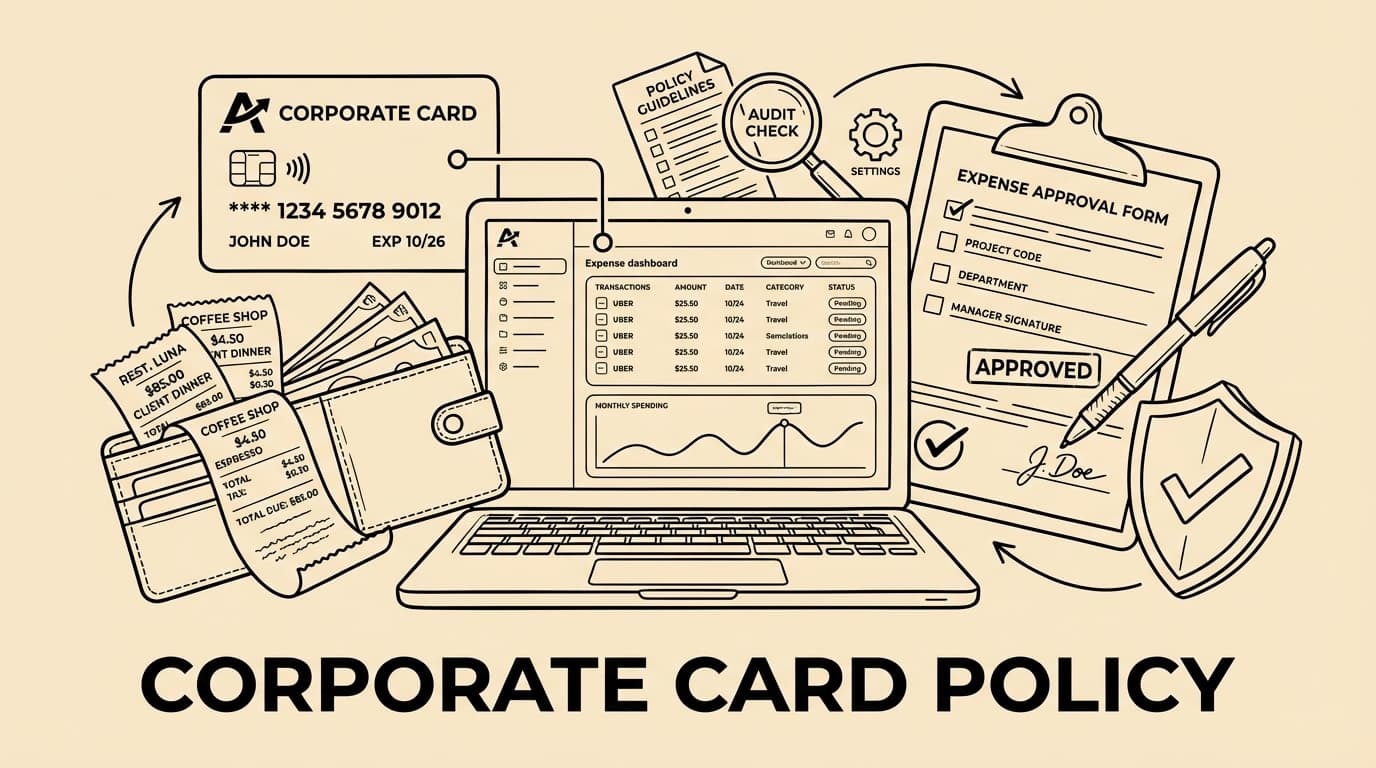
Corporate credit cards are an essential tool for modern businesses, streamlining purchasing, travel bookings, and everyday operational expenses. Yet without a clear, enforceable corporate card policy, they can quickly become a source of overspending, misuse, and audit headaches. According to the Association of Certified Fraud Examiners, organisations without robust expense controls lose an estimated 5% of revenue to fraud each year — and corporate card misuse is one of the most common culprits.
Whether you are launching a corporate card programme for the first time or tightening controls on an existing one, a well-drafted policy saves time, reduces risk, and creates transparency across your organisation. In this guide, we walk you through every section your policy should include, provide a ready-to-use template, and share best practices drawn from finance teams at companies of every size.
Why Every Company Needs a Corporate Card Policy
A corporate card policy is much more than a bureaucratic formality. It is the single document that sets expectations for every cardholder in the organisation. Without one, employees must guess what is acceptable, finance teams must adjudicate disputes without a reference point, and auditors are left piecing together intent from transaction data alone.
A strong policy achieves several things at once. First, it defines who may hold a card and under what conditions. Second, it specifies what expenses are permitted, along with spending limits by category and role. Third, it lays out the process for documentation, approval, and reconciliation. And finally, it describes the consequences of non-compliance, from verbal warnings to card revocation and disciplinary action.
Companies that implement a clear corporate card policy typically see a 30–40% reduction in policy violations within the first quarter, simply because employees know exactly what is expected of them.
Key Components of a Corporate Card Policy
1. Purpose and Scope
Open with a brief statement explaining why the policy exists and who it applies to. Be explicit: does the policy cover all employees, or only those in specific roles or departments? Does it extend to contractors or temporary staff?
Example language: "This policy governs the issuance, use, and reconciliation of corporate credit cards issued by [Company Name]. It applies to all full-time employees who have been approved to hold a corporate card by the Finance Department."
2. Eligibility and Card Issuance
Specify who can request a card, the approval workflow, and any prerequisites (minimum tenure, manager endorsement, completion of expense policy training). Include the process for requesting additional cards or raising credit limits.
- Eligibility criteria: Role level, travel frequency, or departmental need.
- Approval chain: Direct manager sign-off, then Finance approval.
- Onboarding: Require new cardholders to sign an acknowledgement form confirming they have read and understood the policy.
3. Permitted and Prohibited Expenses
This is the heart of the policy. Be as specific as possible. A vague statement like "reasonable business expenses" invites interpretation. Instead, provide categorised lists.
Permitted expenses typically include:
- Business travel (flights, hotels, rail, taxis/rideshares)
- Client entertainment and meals (within per-meal limits)
- Office supplies and equipment under a defined threshold
- Software subscriptions pre-approved by IT
- Conference and training registration fees
- Fuel and tolls for authorised business travel
Prohibited expenses typically include:
- Personal purchases of any kind
- Cash advances (unless specifically authorised)
- Gift cards or vouchers
- Fines, penalties, or late fees
- Political or charitable donations
- Alcohol (or alcohol above a defined per-event cap)
4. Spending Limits
Define per-transaction, daily, and monthly limits by role or seniority. Many companies use a tiered structure:
| Role Level | Per-Transaction Limit | Monthly Limit |
|---|---|---|
| Individual Contributor | EUR 250 | EUR 1,500 |
| Manager | EUR 1,000 | EUR 5,000 |
| Director / VP | EUR 5,000 | EUR 15,000 |
| C-Suite | EUR 10,000 | EUR 50,000 |
State clearly that transactions above the per-transaction limit require pre-approval from a designated authority (e.g., CFO or Finance Director).
5. Receipt and Documentation Requirements
Receipts are the backbone of expense compliance. Your policy should mandate that cardholders capture and submit a receipt for every transaction, ideally within 5 business days. Specify the minimum information required on each receipt: vendor name, date, itemised list, total amount, and payment method.
Tools like Bill.Dock make this step effortless — employees simply photograph the receipt with their phone, and OCR technology extracts the data, matches it to the card transaction, and flags any discrepancies automatically. This eliminates the end-of-month scramble and drastically reduces missing-receipt rates.
6. Reconciliation and Approval Workflow
Define who reviews and approves corporate card statements. A common workflow is:
- Cardholder reviews statement and attaches receipts to each line item.
- Direct manager approves the statement.
- Finance team performs a secondary review for policy compliance.
- Flagged items are returned to the cardholder for explanation or correction.
Set a deadline — for example, all statements must be reconciled within 10 business days of the statement closing date. Late reconciliation should have consequences (e.g., temporary card suspension).
7. Lost or Stolen Cards
Provide clear instructions for reporting a lost or stolen card. Include the card issuer's emergency phone number, the internal contact (usually Finance or the office manager), and the expected timeline for reporting (e.g., within 24 hours of discovery).
8. Card Return and Offboarding
When an employee leaves the company, changes role, or no longer needs a card, describe the process for card cancellation. The card should be deactivated on or before the employee's last working day, and any outstanding balance must be reconciled before the final paycheck is processed.
9. Consequences of Non-Compliance
Be explicit about what happens when the policy is violated. A graduated approach works well:
- First violation: Written warning and mandatory re-training.
- Second violation: Card suspension for 30 days.
- Third violation or serious breach: Permanent card revocation and referral to HR for disciplinary action.
- Fraudulent use: Immediate termination and potential legal action.
Corporate Card Policy Template
Below is a ready-to-adapt template. Copy it into your company's policy management system and customise the bracketed fields.
Section 1 — Purpose
[Company Name] issues corporate credit cards to eligible employees to facilitate authorised business purchases. This policy defines the rules governing card issuance, permitted use, documentation, reconciliation, and enforcement.
Section 2 — Eligibility
Corporate cards may be issued to full-time employees at the [Manager / Senior Individual Contributor] level and above, subject to approval by the employee's direct manager and the Finance Department. Temporary or contract staff are not eligible unless a written exception is granted by the CFO.
Section 3 — Permitted Use
Cards may be used exclusively for legitimate business expenses including: business travel, client entertainment (within approved limits), office supplies, software subscriptions approved by IT, and conference fees. All other uses are prohibited.
Section 4 — Spending Limits
Refer to Schedule A for role-based spending limits. Any purchase exceeding the per-transaction limit requires prior written approval from [CFO / Finance Director].
Section 5 — Documentation
A receipt or invoice must be submitted for every corporate card transaction within [5] business days. Receipts must show the vendor name, date, itemised purchases, and total. Digital capture via [Bill.Dock / approved expense tool] is accepted and encouraged.
Section 6 — Reconciliation
Monthly statements must be reviewed, annotated, and submitted with receipts within [10] business days of the statement date. Managers must approve within [5] business days of submission. Unreconciled statements will result in temporary card suspension.
Section 7 — Lost / Stolen Cards
Report immediately to [card issuer phone] and notify [finance@company.com] within 24 hours. The cardholder is responsible for any unauthorised charges incurred before the report is filed.
Section 8 — Offboarding
Cards must be returned and deactivated on or before the employee's last working day. Outstanding balances will be deducted from the final payroll settlement.
Section 9 — Enforcement
Violations will be addressed through a graduated disciplinary process: written warning, card suspension, permanent revocation, and/or termination. Fraudulent use will be reported to law enforcement.
Best Practices for Rolling Out Your Policy
Communicate Early and Often
Do not simply email the policy and hope people read it. Host a short all-hands session or department briefing to walk through the key points. Follow up with a one-page cheat sheet that cardholders can keep at their desk or save on their phone.
Make Compliance Easy
The number one reason employees fail to submit receipts on time is that the process is too cumbersome. Adopt a mobile-first expense management tool that lets employees snap a photo of the receipt the moment they make a purchase. Automated matching between receipts and card transactions — a feature offered by tools like Bill.Dock — removes manual data entry and keeps compliance rates above 95%.
Audit Regularly
Conduct quarterly spot audits of a random sample of corporate card statements. This keeps cardholders accountable and helps you identify patterns — such as a particular merchant category showing unusually high spend — before they become problems.
Review and Update Annually
Business needs change. Spending limits that made sense two years ago may be too low (or too high) today. Schedule an annual policy review with stakeholders from Finance, Legal, and HR to ensure the policy remains fit for purpose.
Common Mistakes to Avoid
Setting limits too high: Generous limits signal trust, but they also increase exposure. Start conservative and raise limits based on demonstrated need and compliance history.
Ignoring small transactions: Fraud often starts small — a coffee here, a personal Uber there — to test whether anyone is watching. Apply the same documentation requirements regardless of amount.
No consequences for late reconciliation: If there is no penalty for submitting a statement two months late, employees will procrastinate. Automatic card suspension after a defined grace period is a highly effective motivator.
Failing to distinguish between card types: If your company issues both purchasing cards (for procurement) and travel cards (for individual employees), each should have its own policy section with tailored rules.
How Technology Simplifies Corporate Card Management
Modern expense management platforms have transformed the way companies handle corporate cards. Real-time transaction notifications alert both the cardholder and their manager the moment a purchase is made. Automated policy checks flag out-of-policy spending before it reaches the approval stage. And integration with accounting software means reconciled transactions flow directly into the general ledger with the correct cost centre coding.
If your team is still relying on spreadsheets and email chains to manage corporate card expenses, consider switching to a purpose-built solution. The time saved on manual reconciliation alone typically pays for the software within the first quarter.
Frequently Asked Questions
Can an employee use a corporate card for personal expenses in an emergency?
Most policies prohibit personal use entirely. If your company wishes to allow emergency exceptions, define the process clearly: the employee must notify their manager within 24 hours, repay the amount within 5 business days, and document the reason in writing.
What happens if a receipt is lost?
Require a signed lost-receipt affidavit that includes the vendor, amount, date, and business purpose. Set a maximum number of affidavits per year (e.g., three) before escalating to a formal warning.
Should we set per-meal or per-day entertainment limits?
Per-meal limits are generally more effective because they prevent a single extravagant dinner from consuming the entire daily allowance. Common limits range from EUR 25–50 per person for meals and EUR 100–150 per person for client entertainment events.
How often should spending limits be reviewed?
At minimum annually, or whenever there is a significant change in business operations such as entering a new market, scaling the sales team, or shifting to remote work.
Do we need a separate policy for virtual corporate cards?
Virtual cards (single-use or vendor-locked numbers) are increasingly popular for online subscriptions and one-off purchases. While the same overarching policy applies, add a section covering virtual card issuance, expiry, and the specific use cases they are intended for.
Conclusion
A well-crafted corporate card policy protects your company, empowers your employees, and gives your finance team the structure they need to operate efficiently. Use the template and best practices in this guide as your starting point, adapt them to your organisation's size and culture, and invest in technology that makes compliance the path of least resistance. The result is a programme that works for everyone — from the new hire making their first business purchase to the CFO reviewing the quarterly expense report.