
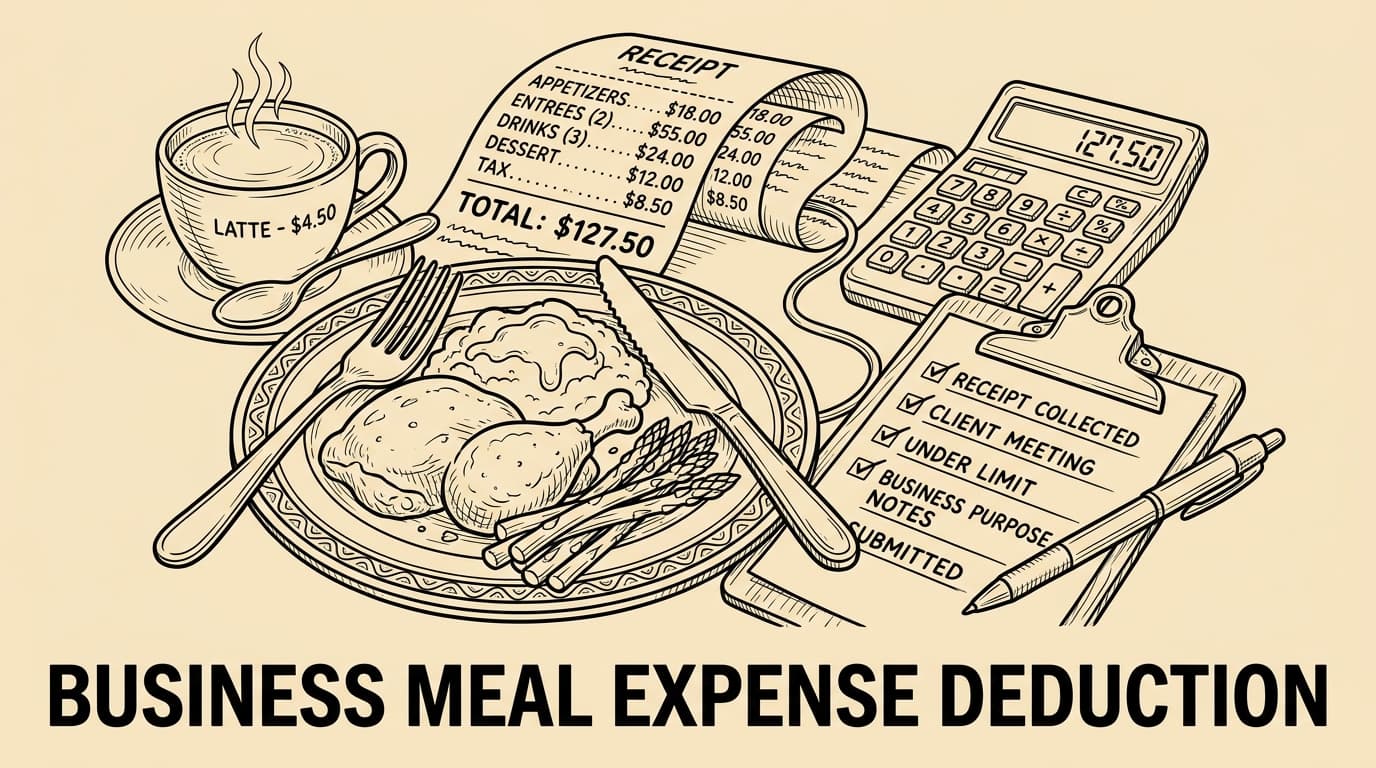
For consultants and self-employed professionals, business meals are a regular part of client relationships, networking, and deal-making. Understanding exactly which dining expenses qualify for a tax deduction — and how to document them correctly — can save you hundreds or thousands each year. This guide breaks down the rules for business meal deductions across the UK, US, and DACH regions, explains what percentage is deductible, and shows you how to stay compliant without the paperwork headache.
What Qualifies as a Deductible Business Meal?
Not every restaurant receipt is a valid business expense. Tax authorities on both sides of the Atlantic require that a meal meet specific criteria before it becomes deductible.
In the United States, under IRS rules (IRC §274), a business meal is generally 50% deductible if:
- The expense is ordinary and necessary for your trade or business.
- A business owner or employee is present at the meal.
- The meal is not lavish or extravagant given the circumstances.
- The primary purpose is a genuine business discussion — not purely social.
In the United Kingdom, HMRC allows deductions for meals that are wholly and exclusively for business purposes. Entertaining clients is generally not deductible (it is treated as client entertainment), but meals with employees or during a business journey can qualify. The distinction between subsistence (your own meal while travelling) and client entertainment is critical.
In Germany, Austria, and Switzerland (DACH), business meals fall under Bewirtungskosten (hospitality expenses). Under §4 Abs. 5 Nr. 2 EStG, 70% of documented meal expenses for business purposes are tax-deductible. The remaining 30% is non-deductible. Strict documentation requirements apply under GoBD.
Deductible Percentages at a Glance
| Country/Region | Standard Deductible % | Notes |
|---|---|---|
| USA | 50% | Applies to most business meals; 100% for certain employee meals on premises |
| UK | 0–100% | Own subsistence while travelling: 100%; Client entertainment: 0% |
| Germany (DACH) | 70% | §4 Abs. 5 EStG; GoBD-compliant receipt required |
Documentation: What You Must Keep
The most common reason business meal deductions are rejected is missing or incomplete documentation. Here is exactly what you need to retain:
- The original receipt — itemised, showing date, venue, and total (including tip where applicable).
- Names of attendees — who was at the meal, and their business relationship to you.
- Business purpose — a brief note on what was discussed (e.g., "Q2 strategy review with client ABC").
- Amount paid — in the local currency, with VAT or tax shown separately if applicable.
In Germany, the GoBD requires that digital scans of paper receipts be unalterably archived. A photo taken on your phone qualifies, provided it captures all details legibly and the file is stored in a tamper-proof system.
In the US, the IRS recommends keeping records for at least three years after the return is filed. HMRC in the UK advises keeping records for six years.
Common Mistakes Consultants Make
1. Claiming 100% When Only 50% Applies
One of the most frequent errors is claiming the full amount of a business meal instead of the allowable percentage. In the US, only specific circumstances allow 100% deduction — such as meals provided for the employer's convenience on business premises.
2. Missing the Business Purpose Note
A receipt alone is not enough. Without a contemporaneous note of who attended and what was discussed, the deduction is vulnerable to disallowance. Write the note at the time of the meal, not weeks later.
3. Mixing Personal and Business Meals
If your spouse joins a dinner that is primarily social but you discuss a business topic briefly, the meal is likely not deductible. The primary purpose test applies.
4. Losing Paper Receipts
Receipts fade, get lost in wallets, or are accidentally thrown away. Digitising receipts immediately using tools like Bill.Dock means you always have an archived, searchable record — even years later when HMRC or the IRS comes calling.
Practical Tips for Maximising Your Deductions
- Scan at the table. Use your phone to capture the receipt before you leave the restaurant. Ink fades within weeks on thermal paper.
- Write the purpose immediately. Add a short note to the digital receipt while the meeting is fresh in your mind.
- Separate your personal and business cards. Using a dedicated business card for business meals makes reconciliation effortless.
- Know the local rules. If you consult internationally, the rules differ significantly. A meal that is 50% deductible in the US may be 0% deductible in the UK if it is classified as client entertainment.
- Track currency and exchange rates. If you pay in a foreign currency, record the exchange rate on the day of the expense.
The Role of Expense Management Tools
Managing meal receipts manually — photographing them, emailing them to yourself, then matching them to bank statements — is error-prone and time-consuming. Tools like Bill.Dock automate this process: you capture a receipt, the system extracts the merchant, amount, date, and VAT automatically, and the expense is instantly categorised and ready for your tax return or accountant review.
For consultants billing multiple clients, Bill.Dock also allows you to tag expenses by project or client — making it easy to identify which meals relate to which engagement when it comes to invoicing or expense reporting.
FAQ
Can I deduct a meal where no business was conducted?
Generally, no. In the US, the IRS requires a business purpose. In Germany, the same applies — Bewirtungskosten must have a documentable business reason. A meal with a client where you only discuss personal topics does not qualify.
Are tips and service charges deductible?
Yes, in most jurisdictions tips are included in the meal cost and subject to the same deductible percentage. A 50% meal deduction in the US includes the tip.
What about alcohol at a business dinner?
Alcohol served as part of a business meal is generally deductible at the same percentage as the meal itself, provided the primary purpose of the gathering is business. However, if the tab is primarily alcohol, tax authorities may scrutinise the claim more closely.
Can I deduct my own lunch when working from home?
In most cases, no. Your own meals while working at your regular place of business (including your home office) are a personal expense. Deductions apply to meals away from your regular place of business or for genuine client entertainment.
How do I handle meals in foreign currencies?
Record the original amount and currency, plus the exchange rate on the date of the expense. Your tax authority will want the figure converted to your home currency for the return.
Taking the Next Step
Understanding the rules is the first step; building a reliable system to capture, categorise, and archive your meal expenses is what actually protects your deductions. Manual processes invite errors and gaps. Bill.Dock gives consultants an automated receipt-to-report pipeline — so every business meal is documented correctly from the moment the receipt lands in your hand.
Start your free trial at billdock.io and see how much time you save at tax time.
Conclusion
Business meal deductions are a legitimate and valuable tax benefit for consultants — but they require precise documentation and an understanding of your jurisdiction's rules. Whether you operate under IRS, HMRC, or German tax law, the principles are consistent: document who, what, why, and how much. Build that habit, use the right tools, and your deductions will stand up to scrutiny every time.